
GoAsk.Me is our founder’s separate venture. This case study follows the product experience, development decisions and AI workflow reviewed on 9 October 2026.
01 / The challenge
Start with the need.
Make the next step clearer.
Finding a service often starts with an incomplete brief. A customer knows what needs doing, but may not know the right category, which provider can cover the location, or what a comparable proposal should contain.
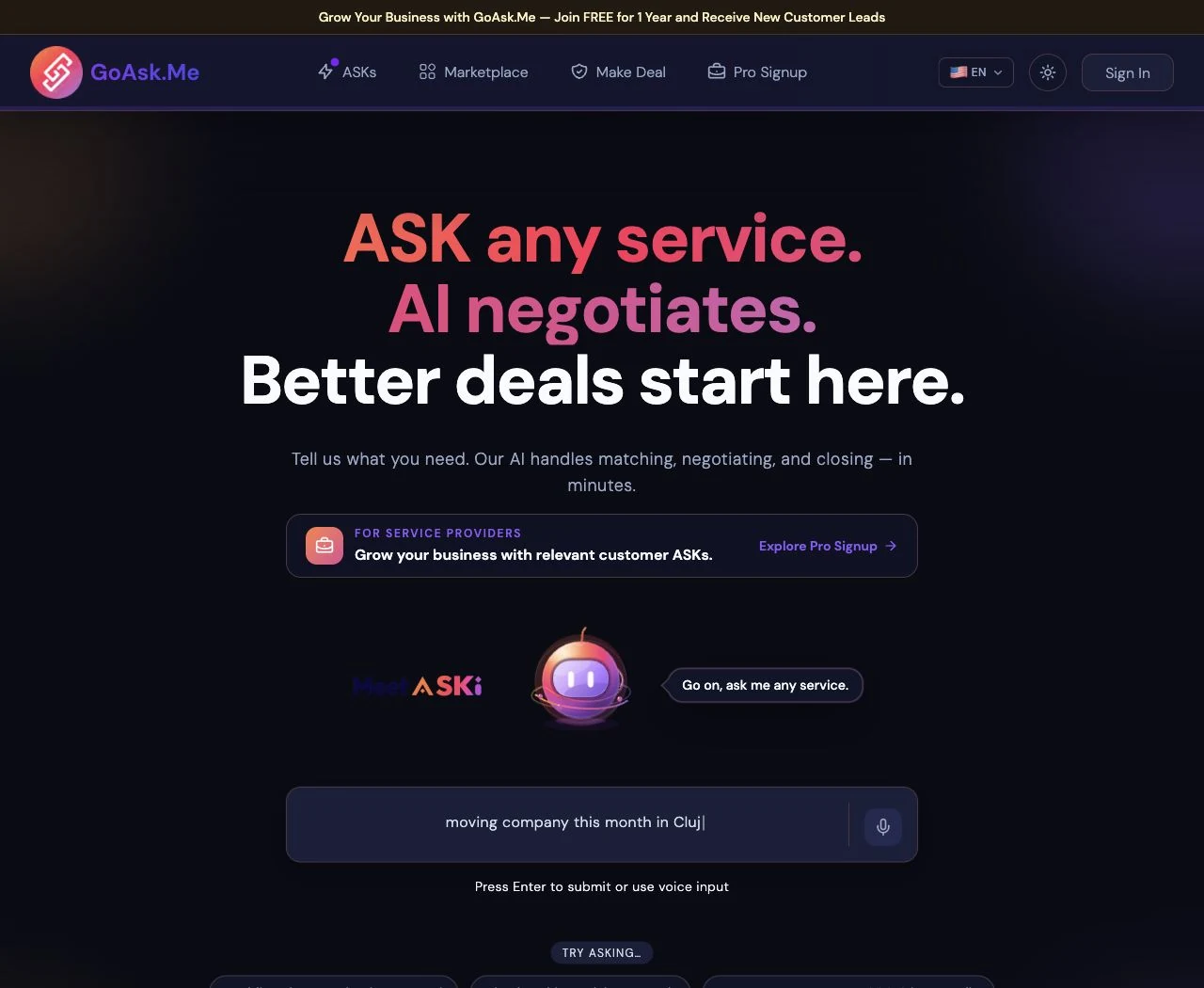
GoAsk.Me brings that journey into one product: describe a need, discover relevant providers, review proposals and work towards an agreement. The challenge is to make AI useful throughout that process while keeping commercial choices understandable and under the parties’ control.
02 / The work
A product perspective on AI.
This founder-led venture gives our work a practical reference beyond a campaign landing page. The project brings together service taxonomy, customer and provider journeys, application development and AI-assisted decisions. The relevant lesson for a client is how those parts connect—not simply which model is used.
A clear path for customers
The customer entry point begins with a service request. Matching considers service fit and practical constraints such as delivery area and provider readiness. A fluent AI response alone is not enough to establish that a provider is suitable.
A useful workspace for providers
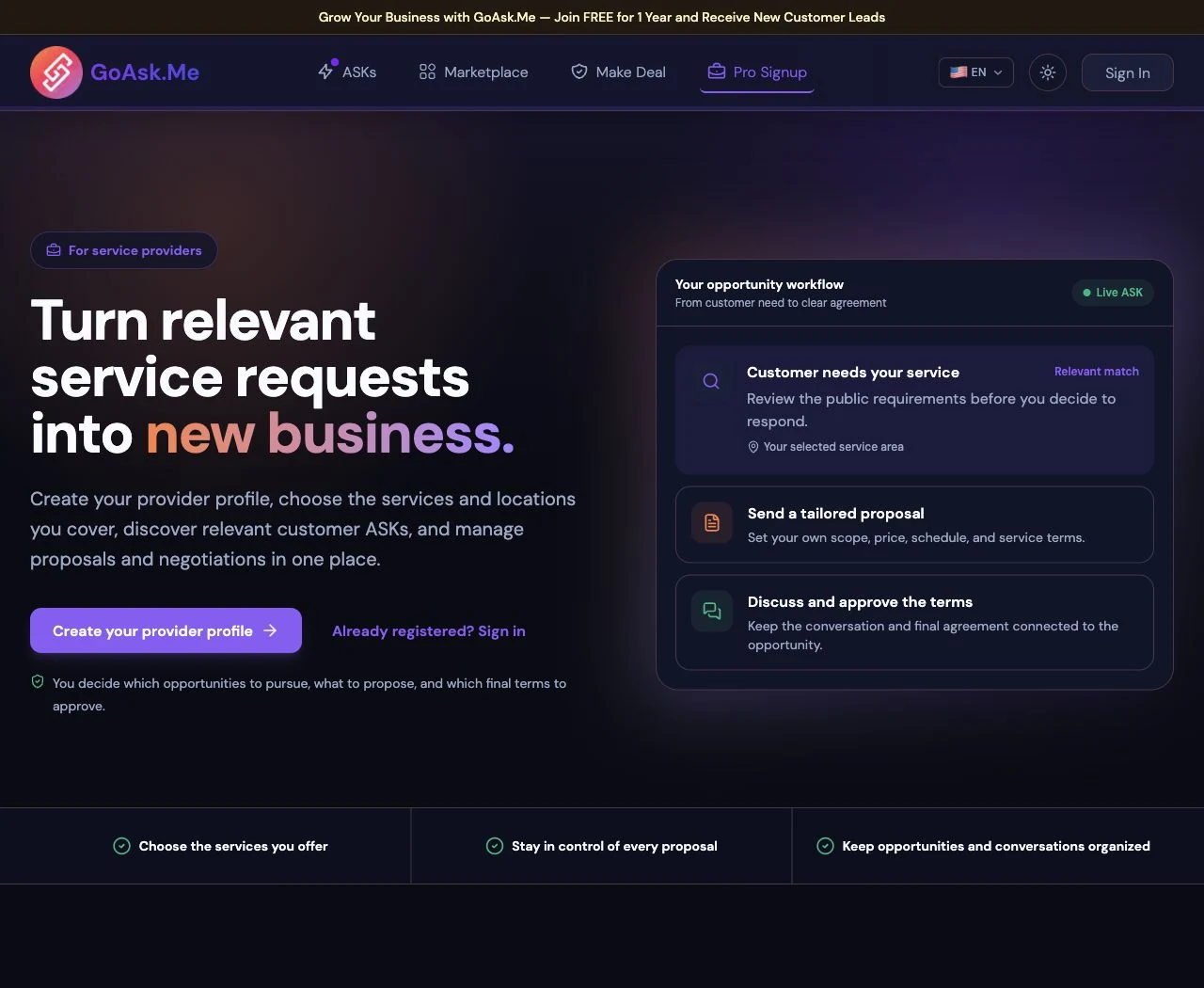
The provider journey asks businesses to define their services and operating locations, review relevant requests and prepare proposals. Scope, price, timing and conditions stay explicit so customers can compare what is actually being offered.
03 / From intent to agreement
Four connected decisions.
-
Describe the request
Capture what the customer needs and clarify the context. A structured service request gives the rest of the workflow something concrete to work with.
-
Assess the fit
Compare the request with provider services, delivery modes and operating areas. The implementation separates eligibility checks from the ranking of suitable candidates.
-
Make a proposal
The provider decides whether to pursue the opportunity and sets the scope, price, schedule and terms. AI assistance supports preparation and discussion.
-
Review and approve
Keep negotiation tied to explicit terms. The agreement flow checks readiness and party approvals; unresolved changes must be addressed before proceeding.
04 / Engineering decisions
Useful AI needs
clear boundaries.
Business rules remain explicit
The reviewed implementation checks service eligibility, geographic coverage, delivery mode and provider availability before presenting a match. Those constraints remain separate from an AI-generated explanation.
Product state and AI reasoning have different roles
Structured product records hold the operational state. AI reasoning and review evidence support decisions, while application rules control permitted changes and progression through the workflow.
Approval is part of the experience
Proposal and agreement screens expose commercial terms and pending changes. The application includes checks for agreement readiness and approval by both parties, rather than treating conversational agreement as sufficient on its own.
05 / What this demonstrates
A working product direction.
A continuing responsibility.
The public site provides customer request entry, a marketplace and a dedicated provider journey. The reviewed implementation contains matching, proposal and agreement workflows. Together, these demonstrate how an AI-assisted service product can connect an initial need to a reviewable commercial process.
Availability depends on the service, location and participating providers. AI can make mistakes, and product capabilities continue to evolve. The results documented here concern the product experience and implementation. Commercial performance figures are not part of this case study.
For a business considering AI, the transferable approach is to start with one useful workflow, define the data and approvals it needs, test its failure cases and measure completed outcomes before expanding automation.
06 / Apply the thinking
What could AI improve
in your business?
We can help define the workflow, the website or application experience, the integrations and the human approvals. Start with the problem you want to solve; we will discuss a practical scope and the evidence needed to evaluate it.