

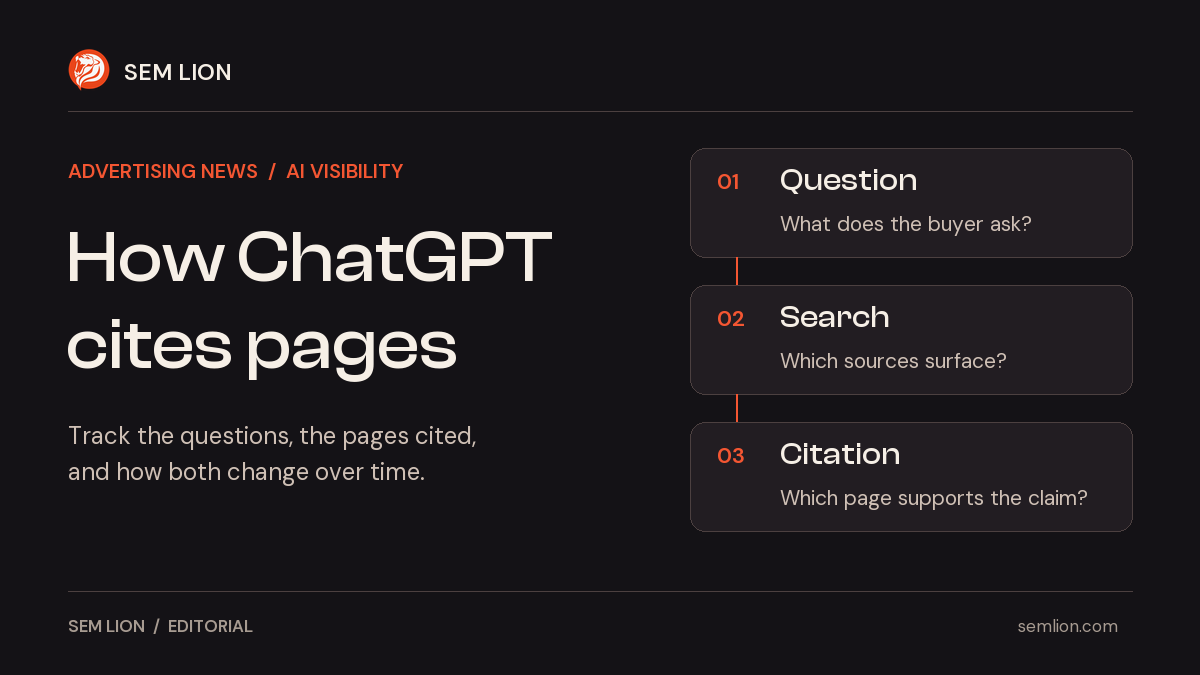
Two pages can cover the same subject and only one may appear as a source in ChatGPT Search. To understand the difference, start with the claim ChatGPT cited and the exact URL that supports it. Then check how often that URL, or any page from your site, appears when you ask the same buyer question again.
Why does ChatGPT cite one page over another?
When ChatGPT searches the web, it may find several pages and cite the ones it uses to support particular claims. OpenAI says ChatGPT Search can rewrite a prompt into more targeted searches and may run additional searches after seeing the first results. You can open an inline citation to see which page is attached to a claim. The Sources panel can also include other relevant links. OpenAI’s ChatGPT Search guide.
In an Ahrefs analysis, many pages surfaced during retrieval without appearing as citations. The titles of cited pages tended to match both the original question and the narrower searches it prompted more closely. When comparing pages, check which one answers the specific question behind the citation. The study describes a pattern in the results, and the pattern can vary by question.
What are fan-out queries, and can you see them?
Fan-out queries are narrower searches that help answer parts of a broader question. For example, a hypothetical buyer asking for a PPC audit in Doha might lead to searches about account access, the audit scope or turnaround time. Those are examples of possible searches. The actual wording can vary with the answer, location and session.
For a manual check in your own ChatGPT Search conversation, open your browser’s developer tools, select Network and reload the conversation. In the request for that conversation, open Response and look for a queries field. Treat anything you find as evidence from that session. The field can change or be absent. In the OpenAI Responses API, some web search calls expose the search queries, and URL citation annotations identify sources used in the answer. A retrieved URL and a cited URL belong in separate fields when you record your findings. OpenAI web search API documentation.
Which sources does ChatGPT cite most often?
General web search supplied most of the citations in the sample. Results pulled through dedicated Reddit, YouTube, news and academic channels were cited at lower rates than general web results. Those categories describe how a result was found. A Reddit thread or YouTube video can also reach ChatGPT through general web search, so the same domain can appear in more than one category.
SEM Lion’s take. Start with the pages buyers can already find when they search for your services. Make those pages clear and specific about what the buyer gets. In your citation audit, record which kinds of pages actually support the answers to your target questions. If buyer questions repeatedly surface a forum thread or a video, look at what it explains and decide whether that format would help you answer the question too.
Does a newer page have a better chance of being cited?
It depends on the question. In the general web results, cited pages covered a wide range of ages and tended to be older than the pages retrieved without a citation. Among news results, cited pages tended to be newer. The difference describes the sample and gives you a reason to look at freshness separately for different types of questions.
SEM Lion’s take. Keep a useful evergreen guide on its existing URL and update it when the facts, examples or advice have changed. If the question is time-sensitive, such as what changed in an ad platform this week, show when the change took effect and what readers should do next. Track evergreen and time-sensitive prompts separately in Lion AI so you can compare how each group responds to meaningful updates.
How do you study why a competing page earned a citation?
Compare the cited page with the page you expected to appear. Start with the sentence the citation supports, then work out which page answers that particular question more directly.
- Check whether your page can be found. Verify that it loads publicly and that your intended URL is indexable and internally linked. Check robots.txt and any firewall rules that apply to OAI-SearchBot. OpenAI crawler guidance.
- Compare the answer on both pages. Read the titles, H1s and opening paragraphs. If the question is what a PPC audit includes, check which page names the deliverables, access requirements and next step. Look for details the cited page backs up with an example, a source or a clear explanation.
- Change what the reader needs. If one page tries to cover unrelated jobs, give each job a clear home. Use a descriptive slug for a new page. If an existing page is already indexed, weigh the value of a URL change and plan the redirect before renaming it.
- Repeat the test. Record the change date, rerun the same prompts and compare against a small set of unchanged pages. Treat a change in one answer as an observation to check again.
How do you track ChatGPT citations and query rankings over time?
Build a fixed set of real buyer prompts and run it on a consistent schedule. Include discovery, comparison and decision questions. For a business serving Qatar and Romania, keep the two markets and relevant languages in separate groups so a change in one doesn’t hide what is happening in the other.
For direct checks in ChatGPT Search, use a fresh conversation and record the exact prompt, date, model or interface, language, market and search setting. Save the response, cited URLs and the claim each source supports. Repeat selected prompts to see how much results vary. Keep failed runs and answers with uncertain citation evidence visible in the report.
- Brand mention rate. The share of analysed answers that name your brand.
- Site citation rate. The share of answers with usable citation evidence that cite your domain. Keep the number of answers in the denominator alongside the rate.
- Cited pages and observed rank. Record which URLs appeared for each question and compare brands using the same set of answers. A rank describes that sample and can change with the prompts, provider or market.
A hypothetical baseline of 6 mentions and 3 site citations across 20 answers with usable evidence gives you a 30% mention rate and a 15% site citation rate. Keep both figures. A brand can be named while the answer cites a review site, a directory or a competitor.
How does Lion AI help monitor AI visibility?
In a connected workspace, open AI Visibility in Lion AI. Run a defined set of prompts against the available providers, including OpenAI where configured. Lion AI saves the answers with their provider, model and route so you can inspect brand mentions, observed ranking and supported citations. Compare matching samples over time and export the evidence when you want to work through page-level changes with your team. API samples and manual checks in the ChatGPT app should be reported as separate measurements.
Start with the questions that influence a real decision, then pick one page to improve and measure again. Open AI Visibility in Lion AI · Explore SEM Lion’s SEO and AI visibility services.
What prompts can you use to start a citation audit?
Use the first prompt in a fresh ChatGPT Search session. Use the second after collecting the answer and reviewing the cited pages.
Search the web and explain how a [buyer type] in [market] should evaluate [service or product] before choosing a provider. Cover [two decision criteria]. Cite sources beside the claims they support and say when details vary by provider or are unavailable.
Using [the saved answer], [its cited URLs] and [our target page], identify the claim each cited page supports. Record what kind of page it is, whether the question depends on current information and when the page was published or substantively updated, if you can verify the dates. Compare the titles, opening answers and supporting evidence. List specific gaps to investigate on our page, cite the evidence for each gap and label uncertain findings. Suggest one change and a way to measure it on the next run.